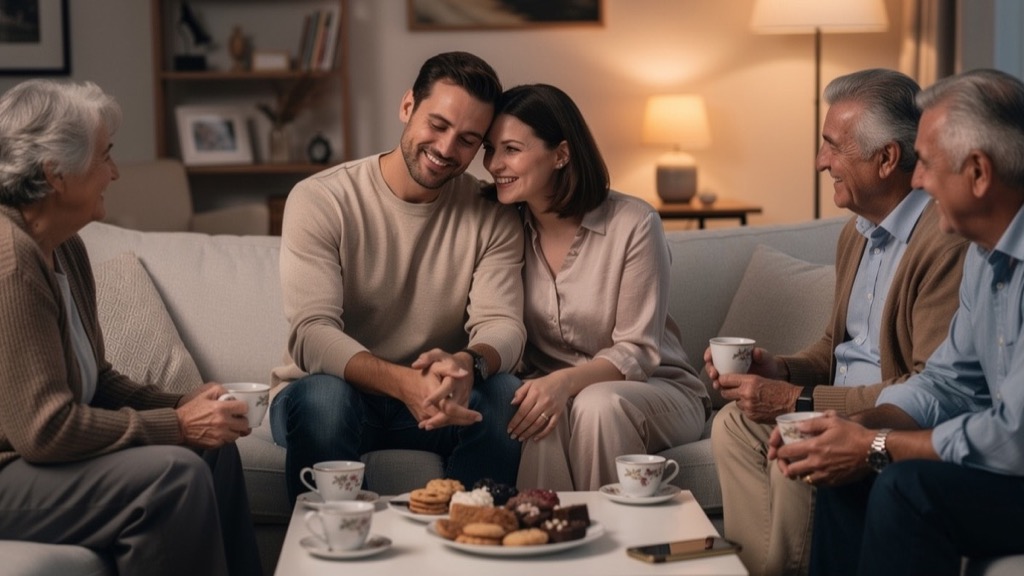
When two people become two families
At some point it becomes clear that this is more than getting to know each other. You found each other on an app, at a wedding or through friends, the families have met for the first time, and the word marriage is no longer a joke. In many Albanian families, this is where a path with its own stages begins. If you know the stages, you can shape them instead of being swept along.
This guide picks up where the first visit to the family ends. It walks through asking for her hand, the engagement, the time that follows and the wedding itself, all the way to the registry office. Customs differ between Kosovo, Albania, North Macedonia and Montenegro, often even from village to village. Where there are variations, it says so.
One thing first: none of this is compulsory. Some couples go through every stage, others marry at the registry office and celebrate afterwards with a small circle. Both are an Albanian wedding, as long as it is yours.
The two of you first: what you want before the families talk
Before one family formally approaches the other, the two of you should be on the same page. Do you want a big wedding or a small one? Here or back home? Where will you live afterwards, and roughly when should it happen? These questions sound like something for later, but once the parents are involved, everyone has an opinion on them.
Also work out how much say you want the families to have. In some families the groom’s father plans practically everything, in others the parents expect the couple to decide and simply want to celebrate with them. If your two families are very different on this, you will otherwise only find out once a venue has been booked.
A conversation like this is not a negotiation against your families. It gives you a shared line you can come back to later. If you can say ‘We’ve already talked about that’, you will sit at your parents’ table a lot more calmly.
Asking for her hand
In the traditional form, the man’s family visits the woman’s family and asks for her hand. Usually the father, an uncle or another respected man of the family goes, often with their wives. In the past a go-between, the shkues, led the conversation and had brought the families together in the first place. Today that role is often only symbolic, or it disappears entirely because the couple found each other on their own.
Worth knowing: these days the answer is almost always settled in advance. You have made your decision, the parents know, and the visit makes official what everyone already suspects. In some families it is still part of the ritual that the woman’s family does not say yes at once but asks for a little time to think it over. That is not a refusal but a formality, and your partner should prepare you for it.
For the woman’s family it is an evening of hospitality. There is coffee, something sweet, often a meal, and by the end a rough frame for the engagement is sometimes already being discussed. The man’s family brings sweets, and in some regions a first gift for the bride. What exactly is expected is best asked discreetly through the couple beforehand.
The fejesa: rings, gifts and a party
Once the answer is yes, the engagement follows, the fejesa. It can be an evening in the living room or a party with live music in a hall, depending on the family and the budget. At its centre are the rings the couple put on each other, often in front of both families. From that moment on, the relatives see you as promised to each other.
In many families, especially in Kosovo and North Macedonia, the man’s family brings gifts for the bride. Usually that means gold jewellery, plus clothes or fabrics, and much of it is shown to the guests. In some regions this gift is called the nishan. How much is expected varies hugely from family to family, and this is exactly where pressure builds easily.
So talk openly beforehand about what feels appropriate, and when it comes to money, let your parents settle it between themselves. An honest conversation between the two mothers often prevents more trouble than any agreement between the two of you. And remember: guests remember the mood of the evening longer than any ring.
The time between engagement and wedding
How long you stay engaged varies a lot. Some marry the same summer, others take their time until their studies are finished or a flat has been found. For the families, the length usually matters less than whether there is a date. In many families, an engaged couple without a plan will soon be asked about one.
During this time the roles shift. You are now welcome at the other family’s celebrations, funerals and holidays, and often expected there. Missing Bajram, Christmas or a wedding among the relatives gets noticed. That can be tiring, but it is also when you get to know the people you will be celebrating with from now on.
Some families still have clear ideas at this stage about what is proper for an engaged couple, for example staying overnight or travelling together. Others have long been relaxed about it. Ask how your parents see it beforehand, not in the middle of an argument. Then decide together where you will be considerate and where you will not.
Where and how big: here, back home or both
The first big decision is the place. Many diaspora couples marry in the summer back home, where the grandparents and half the relatives live anyway. Others celebrate in Germany, Switzerland or Austria, where friends, colleagues and their own generation are at home. Quite often there end up being two parties, one here and one there.
Albanian weddings are often big, and the guest list is the most common point of conflict. Parents think of everyone who once invited them, of neighbours from the village and of relatives you have never met. To them this is not excess but an obligation that has grown over the years. You do not have to accept every name, but it helps to understand that logic before you start cutting.
Costs also follow habits that differ from region to region. Often the man’s family hosts the main celebration and the woman’s family the evening before, but that is not a fixed rule. Many guests give money, which covers part of the costs. Still, do not count on it; set a budget you could carry even without those envelopes.
Kanagjegji and the days of the dasma
Before the wedding, in many regions the bride’s family holds an evening of its own, the kanagjegji or henna night. Women from the family and the neighbourhood sing, dance and paint the bride’s hand with henna. For many brides it is the most moving part, because it still belongs entirely to their own family rather than to the big celebration.
The dasma itself lasts one day or several, depending on the family. One moment hardly any family leaves out is fetching the bride: the groom’s party, the krushq, arrive at her parents’ home with music and take her with them. The farewell from her parents at the door is often quiet and touching, even if the dancing starts again shortly after.
For the two of you, that mainly means planning breaks. At an Albanian wedding everyone wants a photo, a dance and a few words. If you do not agree beforehand when you will slip away briefly to eat something or catch your breath, you will experience your own wedding in passing.
Registry office, religion and paperwork
In Germany, Switzerland and Austria you are only legally married through the registry office. A religious ceremony with an imam or a priest matters a great deal to many families, but it does not replace marriage before the state. In Switzerland the civil ceremony even has to take place before the religious one. So work out early in which order you plan what.
If one of you holds a passport from Kosovo, Albania or North Macedonia, the registry office will usually need documents from that country. Birth certificates, proof of single status and translations often take longer than expected. Ask the registry office where you live exactly which documents it requires, and start months before the date you have in mind.
If you want to marry back home, also check whether and how the marriage will be recognised there and here. The rules depend on citizenship and place of residence, and they change. The only reliable source is the responsible authority, not the advice of a cousin who did it differently a few years ago.
When your ideas drift apart
Hardly any wedding gets planned without two families seeing something differently. Sometimes it is the number of guests, sometimes the place, sometimes a custom that is sacred to one side and unfamiliar to the other. That is normal and no sign that something is wrong with your relationship.
One simple rule works well: everyone talks to their own family. If your mother is unhappy with the guest list, you explain it to her, not your partner. That way nobody has to lose face in front of their future in-laws, and conflicts stay where they are easiest to resolve.
And remember what it is all about. On this day the families also celebrate themselves, their roots and what they have built far from home. You can give them room for that and still insist that it remains your wedding. If you manage both, you start your marriage with two families behind you instead of stuck between them.