A visit that means more than it looks
In many Albanian families, bringing a partner home for the first time is not a casual moment. For the parents, the visit is often a statement in itself: this is serious. Even if the two of you see it as a relaxed coffee, the family may already be thinking about the next steps.
That is no reason to put the visit off. It is a reason, though, to agree between the two of you beforehand on what it means for you. If you both know how it is meant, you can gently slow things down when someone at the table suddenly starts talking about a date.
This guide takes you through the visit itself: getting ready, arriving, the questions at the table and the days afterwards. It is written for both sides, the person being introduced and the person doing the introducing. Where customs differ from family to family, it says so.
Before you go: who will be there and what they already know
Ask your partner exactly who will be there that day. Often it is not just the parents, but siblings, a sister-in-law and maybe an uncle who happens to drop by. If you expect two people and walk into a full living room, you will feel ambushed for no reason.
Also work out what the family already knows about you. Do they know your job, your background, your age, and do they know how you met? Nothing is more awkward than telling a story at the table that your partner has told the parents differently.
And agree on when you will leave. A first visit does not have to take the whole evening. If you mention beforehand that you have plans after coffee or after dinner, there is no awkward back and forth at the door later on. A line like ‘We’re due at friends’ at seven’ is all it takes.
How to tell them where you met
The question comes almost every time, and many people dread it more than they need to. If you met through a dating app, there is no need to hide it. In plenty of families it no longer surprises anyone, even if the parents met in a completely different way.
What helps is a short, honest version you have agreed on together. ‘We met on an app for Albanians and wrote to each other for a while before we met in person’ answers the real worry, which is whether this is serious. Details about other profiles you saw along the way do not belong at this table.
If you met through mutual friends, at a wedding or during the summer back home, the story is easy anyway. Then the family will mainly want to know who those friends are. Expect it to turn out quickly that your families know more people in common than you thought.
What to bring
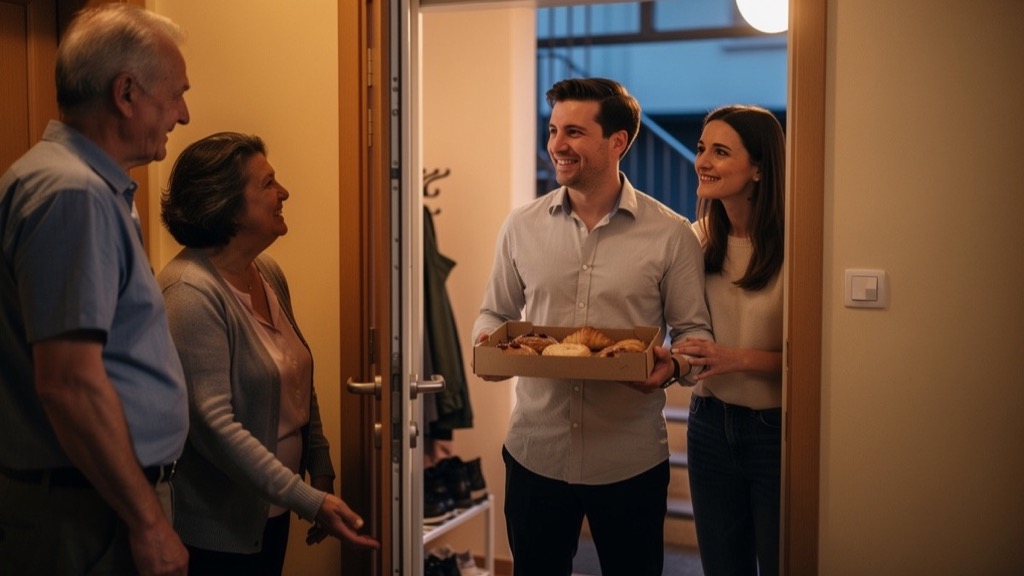
You do not turn up empty-handed at an Albanian home. Pastries or sweets from a good bakery are the usual choice, flowers for the mother, sometimes coffee or chocolates. It should be a gesture, not a performance. A box of baklava from the bakery round the corner is just as right as chocolates from a fancy shop.
That is exactly why more expensive is not better. A showy gift on a first visit can look as if you are trying to buy an impression, and it puts the family under pressure to match it when they visit you. Ask your partner what the family likes to eat and bring exactly that.
With alcohol, caution is wise. In some families a bottle of raki belongs on the table as a matter of course, in others nobody drinks at all, out of faith or simply out of habit. If you are not sure, leave the bottle at home and take the sweets.
Arriving: shoes, greetings and the first coffee
In many Albanian homes, shoes come off at the door. Offer to take yours off without being asked, even if they tell you to keep them on. Often that is pure politeness. Clean socks without holes matter more than your shoes that day.
Greet the older people first, usually the father and mother, then everyone else. Whether it is a handshake, a hug or kisses on the cheek varies from family to family, and it is perfectly fine to follow their lead. If an older person comes into the room later, stand up for a moment. People notice, precisely because it has become rare.
Then there is almost always coffee, often Turkish coffee, with something sweet. Accept what you are offered, and do not turn it down three times to look modest. Hospitality is a matter of honour in Albanian families, and refusing everything makes things hard for your hosts.
The questions at the table
Expect questions about your family, your job and your plans. Where is your family from, which town exactly, and what is the family name? What do your parents do? It sounds like an exam, but mostly it is about placing you: the family is looking for connections, for people they know, for a place they recognise. Some families will also ask about your fis, the wider clan your family belongs to.
Answer calmly and specifically, and ask questions back. Asking about their relatives in Kosovo or Albania, about the grandparents’ village or about last summer shows interest without trying too hard. A conversation in which only you are being questioned feels like a job interview to everyone.
If your Albanian is not great, say so openly and try a few sentences anyway. Nobody expects perfect grammar, and an honest attempt is almost always received warmly. Your partner can translate where you get stuck, but should not take you out of the conversation altogether.
The role of the one doing the introducing
If you are introducing your partner to your own family, you are host and bridge at the same time that day. Do not leave them alone with your father in the living room for long while you help in the kitchen. Especially at the start, someone needs to pick up the threads of the conversation and fill the silences.
Prepare your family for one or two things as well. If your partner does not drink coffee, does not drink alcohol or does not eat meat, say so beforehand, so nobody has to explain at the table why the glass or the plate stays full. It saves everyone a small but unnecessary moment of embarrassment.
And stand by your partner if a question goes too far. A friendly ‘We’ll talk about that between the two of us first’ sounds completely different coming from you than as pushback from the person visiting for the first time. You know your family and how to tell them something without anyone losing face.
When things get bumpy
At some point a question may come that is simply too early. ‘So when is the wedding?’ is the classic, often half joking and half serious. A relaxed answer like ‘We’re only just getting to know each other properly, but you’ll be the first to know’ takes the tension out without offending anyone.
Remarks about your background, your job or your family that sting are harder. Do not argue at the table, even if you are right. Bring it up with your partner afterwards, calmly and specifically, and then leave it to them to sort out within their own family.
Stay fair while you are at it. Many parents are just as nervous at a first meeting as you are, and some questions are clumsy rather than hostile. One difficult moment rarely decides your whole relationship with a family.
After the visit
Say thank you the same evening or the next day, ideally through your partner, with your regards to the parents. Some families also appreciate a short message straight to the mother, if you have already swapped numbers. It is a small gesture that people remember for a long time.
What the family says about you afterwards usually reaches you only through your partner, and often only in part. Do not take a guarded ‘Seems like a decent person’ as a rejection. In many families, that is already a good sign.
And keep in mind that this visit is not yet the formal step in which the man’s family asks for the woman’s hand. That comes later, follows its own rules and is usually prepared by both families together. Until then, the first visit can simply be a good afternoon.