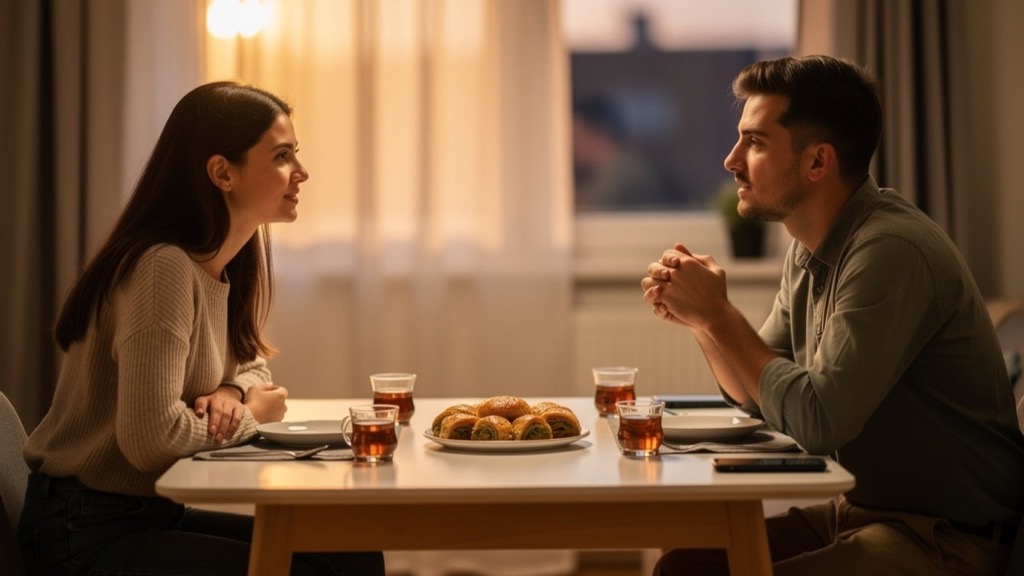
One people, several faiths
Albanians include Muslims, Catholics and Orthodox Christians, plus plenty of people who have little to do with religion at all. Some families come from the Bektashi tradition, an order with a long history in Albania. The dividing line often doesn’t run between villages but right through families: grandma fasts during Ramadan, an uncle married in church, a cousin only goes to Mass at Christmas. Grow up like that and you learn early that faith and origin are two separate questions.
When you start looking for a partner, though, those questions meet. Once the talk turns to the wedding, children and holidays, something private becomes something shared. This guide doesn’t rank any path above another. It shows where these conversations usually get stuck and how to have them before they catch you off guard.
The famous line and what it leaves open
In the 19th century the poet Pashko Vasa wrote that the religion of Albanians is being Albanian. People still quote it whenever they want to say that faith doesn’t divide Albanians. As an attitude it’s lovely, and many families live exactly that way. As an answer to the practical questions of a marriage, it doesn’t get you far.
Sooner or later a couple has to decide whether to marry at the registry office only, in a mosque or in a church. Whether a child is baptised, circumcised, or neither for now. Whether the household fasts during Ramadan, and who visits which family at Christmas and at Bajram. These are less questions of belief than questions of daily life, and they decide whether living together feels easy or hard.
The label says little about daily life
Two people can both tick ‘Muslim’ and still barely understand each other. He prays five times a day and doesn’t drink; she celebrates Bajram with her family and hasn’t been inside a mosque in years. It’s no different for Catholics and Orthodox Christians. The word on a profile tells you where someone comes from, rarely how they live.
Asking about practice works better. What does an ordinary Friday or Sunday look like for you? What of that should stay in a marriage, and what can change? Ask like this and you quickly see whether two labels fit that look mismatched on paper, or the other way round.
Secular is a position too, not a blank. People who don’t believe often still have firm views on whether children should be raised with religion. That belongs in the conversation just as much.
How openly to say it on your profile
There are three honest options. You state your religion because it matters to you and you want to save time. You describe in one sentence how you live it instead, for example that you fast during Ramadan or that Midnight Mass with your family means a lot to you. Or you leave the field empty because it isn’t a deciding factor for you.
The second option is usually the strongest. A sentence about how you actually live says more than a label and doesn’t put off someone who lives the same way but would use a different word. A bare label, by contrast, gets read through everyone’s own assumptions, and those rarely match your life.
What to avoid is phrasing it defensively. Lines that mainly say who you don’t want come across harsher than intended. If shared faith is a condition for you, say so kindly and concretely, for instance that you’re looking for someone to share your faith with day to day.
What families expect
In many families, a future partner’s religion is more the parents’ question than the children’s. Some parents are barely religious themselves and still hope for someone from the same tradition, because it makes the wedding, the holidays and dealing with relatives simpler. Others are devout and are thinking about how their grandchildren will be raised. Both are understandable, and neither is automatically your answer.
It helps to know your own line before anyone asks. Does shared faith matter to you personally, or do you mainly want to avoid conflict at home? Those are two different reasons and they lead to different decisions. Once you’ve settled that for yourself, you can listen to your parents without letting them answer for you.
In the diaspora there’s an extra layer. Some families hold on to their traditions more tightly than relatives back home, because they wanted to preserve them in a foreign country. Something nobody in Tirana or Prishtina thinks twice about can be a big deal in a family in Stuttgart or St. Gallen.
Mixed couples: what to settle early
Couples from a Muslim and a Christian family have existed among Albanians for generations, and many live it without much fuss. It goes smoothly when both have talked early about the same three things: the wedding, children and holidays. It gets hard when those questions only surface once the families are already involved.
On the wedding: one religious ceremony, two, or just the registry office? On children: which names, which rituals, which religious education? Many Albanian families deliberately choose names like Arbër, Besa or Drita, which belong to no religion and so connect both sides. On holidays: who visits whom and when, and do you celebrate both at home?
One point deserves particular clarity: the expectation that one of you converts. If it’s there, it belongs on the table early, not after the engagement. And the couple should decide it, not the parents.
When to bring it up
Not in your first message, but not months later either. A good moment is when you both realise you want to see each other again. At that point the conversation is no longer a test but genuine interest. Raise it too early as a condition and you sound like a form; put it off too long and you risk a disappointment you both could have seen coming.
A simple question works better than a debate about principles. Ask how their family celebrates Bajram, Easter or Christmas. The answer shows almost by itself how much faith shapes their daily life, and you learn a lot about the family you might one day become part of.
Religion in dating apps: filters and privacy
Many apps let you add your religion to your profile. Dua allows a religion entry, and international apps such as Hinge and Bumble have a similar field. That’s practical, but it’s sensitive data: under the EU’s General Data Protection Regulation, information about religion is a specially protected category. Think about whether you want it visible, especially in a small community where people you know might recognise you.
On embla, religion is one of the finer filters that come with embla+, alongside origin, intention, wish for children and minimum height. Distance, age and language are always free to set there. embla hasn’t launched in the App Store yet, so how the filters feel in everyday use can only be judged after that.
A filter doesn’t replace the conversation. It pre-sorts people who picked the same word, not people who live the same way. Use it if shared faith is a firm condition for you, and skip it if you’d rather talk about daily life than filter by a label.