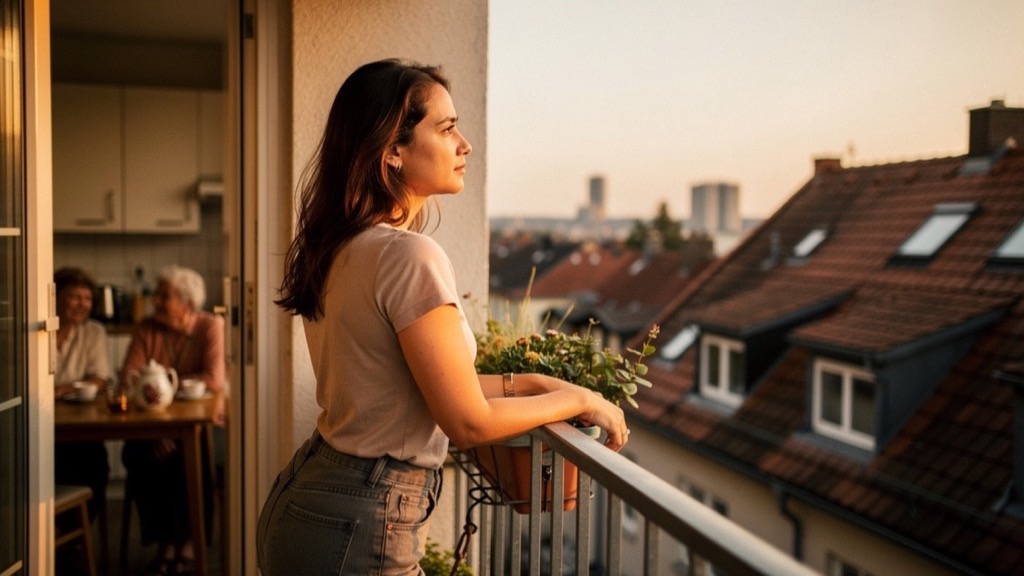
Two rulebooks in one head
You were born in Stuttgart, Zurich or Linz, and your parents came as guest workers or in the nineties. Outside, the rules of the country you grew up in apply. At home there are other rules, rarely said out loud, yet everyone knows them. When it comes to finding a partner, the two rulebooks properly collide for the first time.
That is not a problem to be solved but a situation you live in. Many in the second generation move between both worlds so smoothly that they hardly notice anymore. Only when love comes into it does it become visible how different the expectations are. And that you take both seriously, even if you would never admit it.
This guide is for you if you were born here and raised Albanian. It is not about how home and diaspora see each other, but about how it feels from the inside. What you read here are patterns that come up often. In your family everything may be completely different, and then that is the truth that counts.
What is normal outside and not at home
At school, at university and at work you learn that dating is a private matter. You meet, see whether it fits, and only introduce someone once it is serious. Many Albanian parents see it differently: to them a relationship they know nothing about is already a problem, and one they do know about is almost an engagement.
For many, this leads to a double life. Friends know the partner, a cousin suspects something, the parents know nothing. That can work for a while, but it takes energy, and the longer it goes on, the bigger the moment when it comes out. Some get a surprise: their parents had noticed long ago and were only waiting for a word.
There is no right moment that works for everyone. What helps is an honest question to yourself: are you keeping the relationship quiet because it is not serious yet, or because you dread the conversation? In the first case, holding back is sensible. In the second, the conversation does not get easier with every month; it gets harder.
The language you speak with your parents
Many in the second generation speak Albanian with their parents, but a particular kind of Albanian. It is enough for food, relatives and everyday life, often in the dialect of the village the family comes from. For feelings, doubts and plans for the future, though, the words are sometimes missing. And your parents may speak German well enough for work, but not for a conversation about love.
That is exactly why this conversation is often harder than it needs to be. What you could say with nuance in German suddenly sounds harsh or childish in Albanian. What your mother means in Albanian you may understand word for word, but not with its full weight. Many misunderstandings between parents and children arise not in the matter itself but in translation.
Decide beforehand which language you want to have the important conversation in, and prepare the two or three sentences that matter most. Looking up a word you are missing is not a weakness. Some bring in an older sibling or an aunt who bridges both languages better. What counts is that what you want to say lands the way you mean it.
What lies behind your parents’ questions
‘Which family is he from?’, ‘What will people say?’, ‘When are you finally getting married?’ Questions like these sound like control, and sometimes they are. Often, though, there is something else behind them. Many parents started from nothing abroad, and the family’s good name is one of the few things they brought with them and kept.
Add to that the fear that their children will become strangers to them. A partner who does not speak Albanian or comes from a completely different family can look to parents like a sign that their own roots end with the next generation. You do not have to share that fear. But if you recognise it, you can respond to it rather than just to the question.
And not every family fits this picture. There are parents who react more calmly than their children ever dared to hope, and who mainly want to know whether their child is happy. Some people dread a conversation for years that is then over in ten minutes. Be ready for the difficult version, but do not assume it.
Albanian, not Albanian or somewhere in between
Many in the second generation hope for someone who knows both worlds without needing them explained. Someone who understands why you do not just skip Bajram, and who still shares your shows, your jokes and your expectations of a relationship. That wish makes sense, and it is the reason many search deliberately within their own community.
Others fall in love with someone without an Albanian background, and that stopped being an exception a long time ago. Some families take it in their stride, others need time, and in a few it turns into a major conflict. What often helps is not arguing about the partner’s origins, but showing how he or she relates to the family: turning up to celebrations and learning a few words.
And then there are those who look for someone back home, because they expect to find more there of what they miss in the diaspora. None of these three paths is the only right one. What matters is that you choose yours because it suits you, not because it upsets your parents the least, or the most.
Daughters and sons: not always the same rules
In many families, daughters live by different rules than sons. The brother may come home late and have a girlfriend nobody talks about, while the sister has to account for every evening out. Daughters who experience this often feel it is unfair, and it is.
There is another side, though. In some families sons carry the expectation of looking after their parents later, of living in the same house or nearby and of choosing a wife who goes along with that. That is a burden too, just a quieter one. And in many families this has already shifted, often thanks to older siblings who cleared the way.
For dating, that means asking the other person early on how things were in their family. A man who stood up for his sisters and a woman who fought for her freedom bring different experiences than someone who was allowed everything. These stories say a lot about how someone wants to run a family of their own later on.
Where each of you stands between the worlds
Two people from the second generation have a lot in common, but not necessarily the same place between the worlds. He speaks fluent Albanian and spends every summer in the village, she barely understands her grandmother and has not been back for years. Both are Albanian, just in different ways. Often that only becomes a topic late on.
Concrete questions help. Which language would you speak with your children? Where do you spend Bajram, Christmas or New Year’s Eve, and with whom? How close to your parents do you want to live later on? Ask these early and you will quickly see whether you only share a background or also the same ideas.
Differences are no reason to give up. Some couples complement each other precisely because one keeps the link to home and the other knows everyday life here better. What matters is that you know where you stand before the families decide it for you.
Finding your own measure
Many in the second generation swing between two attitudes: doing everything the way the parents want, or doing everything differently. In the end, both are a reaction to the parents and not a decision of your own. Dating only becomes grown up once you know what you want to keep for yourself.
Maybe the language you want to pass on to your children matters to you, and religion less so. Maybe you want big celebrations and still want to choose for yourself whom you marry. Feel free to write down what from home means something to you and what you only carry along out of habit. The list will change over the years, but it gives you a direction.
With that direction, the conversation with your parents changes too. You are no longer defending a choice against their values; you are showing which of their values you are taking with you. Many parents would rather hear that than any justification, and it is more honest than any compromise you make only out of fear.
Dating apps when you live between two worlds
For many in the second generation, an app is the obvious way to meet people with a similar story, especially outside the big centres. Tinder, Bumble or Hinge mainly show you who is nearby. Albanian apps like Dua connect you specifically with the community, in the diaspora and back home.
embla, which has not yet launched in the App Store, works on a different principle. Every day everyone answers the same daily question, and contact only happens through a specific sentence or a specific photo of the other person. For someone between two worlds, an answer like that can reveal more than a profile picture: how someone thinks, which language they feel at home in, what matters to them. Distance, age and language settings are always free there.
Whichever app you use, be honest about where you stand. A line like ‘Born here, Albanian at home, family matters to me, but I make my own decisions’ says in a few words what otherwise takes weeks. People looking for exactly that will get in touch. And anyone expecting something else entirely will notice too, which saves you both time.