The summer when everyone comes back
In July and August, towns in Albania, Kosovo and North Macedonia fill up with number plates from Germany, Switzerland and Austria. The cafés are packed, there is a wedding somewhere almost every weekend, and on the evening stroll down the main street you see faces you have not seen for a year. For many people from the diaspora, this is the time of year when they meet the most Albanians their own age all at once.
Dating feels different in these weeks than it does at home in Stuttgart or Zurich. There are more people, more opportunities and more eyes watching. On top of that there is the family, often all under one roof in these weeks and very aware of when you head out in the evening. And there is one date hanging over everything: the day you fly back.
This guide is written for both sides. For those who come in the summer, and for those who live there all year and watch the diaspora arrive and leave again every summer. Knowing both sides also helps explain the caution that sometimes stands between them in summer.
Before you travel: set your profile up for summer
If you want to meet someone over the summer, the best place to start is before you fly, with your own profile. Say when you will be where, as precisely as you can. ‘In Tetovo from 20 July to 15 August, Munich the rest of the year’ answers the most important question before anyone asks it. If you are only staying a week, say so too, because that is important information as well.
Whether you can see people at your holiday destination in advance depends on the app. Most apps show you people near your current location, and on several of the big ones a travel feature is a paid extra. At embla, that is exactly what embla+ includes: seeing people at your destination before you get there. embla is not in the App Store yet, though, and for now there is a waiting list.
Chatting to people before the trip is not a must, either. Plenty of people only meet once they are there, and that has an advantage: you see each other before you have pieced together a picture from messages that the real person then has to live up to. If you do write beforehand, plan the first meeting for the first days of your trip, not the last evening.
Once you’re there: the app suddenly shows half the diaspora
Open a dating app in Prizren or Ulcinj in August and you are often in for a surprise. The profiles are not just people who live there, but plenty of other holidaymakers from the diaspora too. Suddenly you see someone who lives in Winterthur, twenty minutes from your place.
That creates its own kind of encounter. Two people who would never have crossed paths at home meet back in the old country and realise they are practically neighbours once the holidays are over. Summer connections like these have it easier than most, because there is no border between them after the flight home.
Update your profile once you are back. ‘In Durrës until mid-August’ only confuses people in October, and anyone who writes to you then has no idea where you actually are. If you keep chatting to someone from the holidays after the summer, say openly that you are back home and how you see things going from here.
Xhiro, café, wedding: meeting people without an app
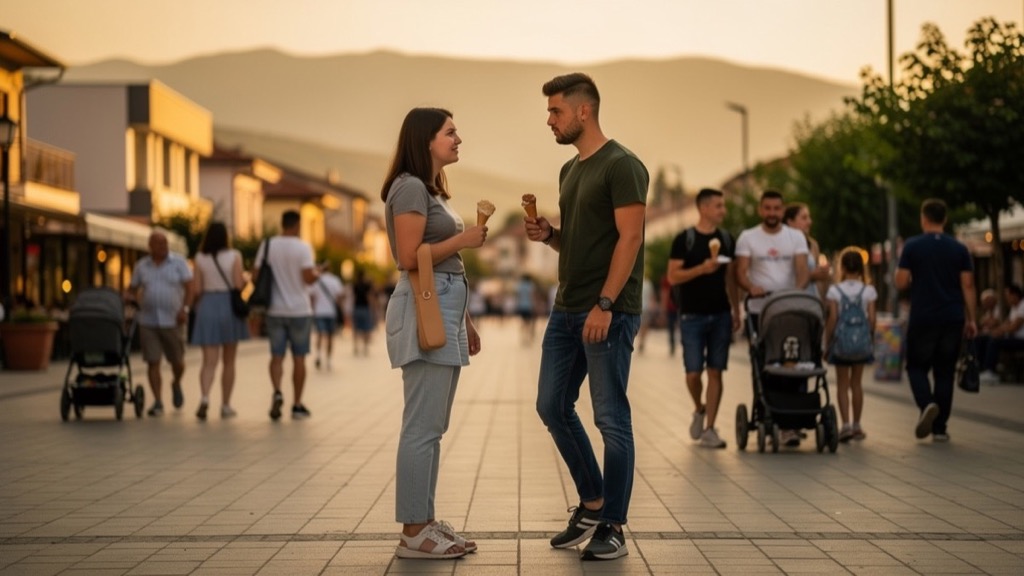
A big part of the summer happens outdoors. The xhiro, the evening stroll along the main street or the promenade, is the place in many towns to see and be seen. If you are out with friends, conversations start easily, and an ice cream or a coffee afterwards is the most natural first step there is.
Summer weddings are the second big meeting place. Many families deliberately hold their celebrations during the holidays so that relatives from abroad can be there. If you meet someone at one, the upside is that you know straight away which family they come from, and the downside is that everyone else knows too.
The app and the street do not rule each other out. Some people see each other in the app first and then recognise each other on the xhiro, others meet in a café first and look up the profile afterwards. All that matters is that you are the same person in both worlds.
Small towns, long memories
Back home, not much goes unnoticed. If you sit in a café with someone in your family’s hometown, you can be sure that an uncle, a neighbour or a cousin will know by the next day at the latest. For you, that may just be awkward. For the person who lives there, it can mean more.
Because you fly back in August, and they stay. Whatever people say about them does not stop when your plane takes off. Women in smaller towns in particular often have to think more carefully about who they are seen with and where, and that deserves respect, not impatience.
A good suggestion takes this into account. A busy café in the next town, a walk by the sea in the early evening, meeting up in a group with friends: these are ways of seeing each other that put nobody on show. Simply ask the other person where they would feel comfortable, and go with that.
Summer fling or more: say it before August is over
A summer is short, and that is exactly why it is easy for things to blur in these weeks. One person may just want a good time on holiday, while the other hopes for something that lasts beyond the summer. Both are fine, as long as they are said out loud.
So say early on how you see it, and ask in return. A line like ‘I’m only here until mid-August, but I’d like to keep getting to know you after that’ is honest and open at the same time. Big promises that nobody can keep by October do more damage than people realise.
For those who live back home all year, the same applies the other way round. It is perfectly fine to ask straight out when someone is leaving and how serious they are. Anyone who dodges the question has often answered it already.
When it gets serious in August
Sometimes a summer turns into more. When it does, one thing helps above all: fixing your next meeting before you leave. A specific date, whether it is New Year’s Eve, Bajram or a long weekend in the autumn, gives you both something to count on.
Talk about how you will stay in touch until then, too, and who in your families should already know. In summer, relatives see a lot for themselves. In winter, they only learn what you tell them. Agreeing on a shared line stops one of you from having told everyone at home while the other has said nothing at all.
Whether it becomes a long-distance relationship or one of you moves one day is not something anyone has to decide in August. All that matters is that you both say honestly whether you could even imagine it. Leaving that question open just carries it into a long winter of voice messages.
If you live there: the summer from the other side
For people who live in Tirana, Prishtina or Tetovo all year round, summer looks different. In July the apps suddenly fill up, and many of the new profiles vanish again at the end of August. After a few summers of that, people grow cautious, and that is understandable.
It helps to see the question of what happens afterwards not as mistrust, but as a foundation. Ask how often the person comes over each year, where they spend the holidays and whether they could imagine moving back one day. The answers quickly show you whether you are dealing with a holiday feeling or with real interest.
And allow yourself the summer anyway. Not everyone from the diaspora is only after a holiday romance, and if you ask honestly and answer honestly, you usually find out soon enough. A summer that does not lead to anything lasting is not a wasted summer, as long as nobody pretended.
Stay safe, on holiday too
The holiday mood makes people careless. Even in summer, meet somewhere busy first, tell a friend where you are, and make sure you can get there and back on your own. A late-night drive to a secluded beach is not a good first evening, however romantic it sounds.
If you first meet someone through an app, check that they are real before you meet. A short video call settles that in a few minutes. Apps check profiles with varying rigour, and embla, for example, verifies by photo matching, a selfie compared against the profile photos, but no check replaces that call.
And be alert as soon as money comes into it. Anyone who asks for help with a ticket, a bill or a visa after a short time is rarely interested in you. That goes both ways, for people in the diaspora and for people back home.