Cologne sits in the middle of Germany’s largest metropolitan region. Between Bonn, Cologne, Düsseldorf and the Ruhr, one city runs straight into the next, and the Albanian community is spread along this whole stretch of the Rhine. If you’re looking for someone here, you’re rarely looking only in Cologne, but across a region you can cross on a regional train.
This page describes what Albanian life in Cologne looks like, where people meet and what apps can do in such a densely populated area. You won’t find figures here, because there are none reliable enough to split by city and origin. The patterns, on the other hand, will be familiar to anyone who grew up between the Rhine and the Ruhr.
One city in a chain of cities
Many Albanian families in Cologne came through work: as guest workers in the Yugoslav era, later as refugees from Kosovo in the 1990s, and in recent years also from Albania and North Macedonia to take up jobs. Their children grew up in Cologne, understand enough of the local dialect to get every joke, and often feel more attached to their own neighbourhood than to the city as a whole.
What sets Cologne apart from Munich or Hamburg is its neighbours. Families don’t just live in Cologne but in Leverkusen, Wuppertal, Düsseldorf and Essen too. Düsseldorf is about half an hour away on the regional express. A wedding in Cologne therefore brings together guests from all over North Rhine-Westphalia, and when you meet someone, you often get to know a second city along with them.
Where people meet in Cologne
Weddings and family celebrations remain the classic setting. They’re often held in large banquet halls on the edge of the city or in the surrounding towns, where there’s room for plenty of guests. Beyond that there are mosque communities, Catholic parishes and associations with Albanian-language activities, football teams and cultural evenings.
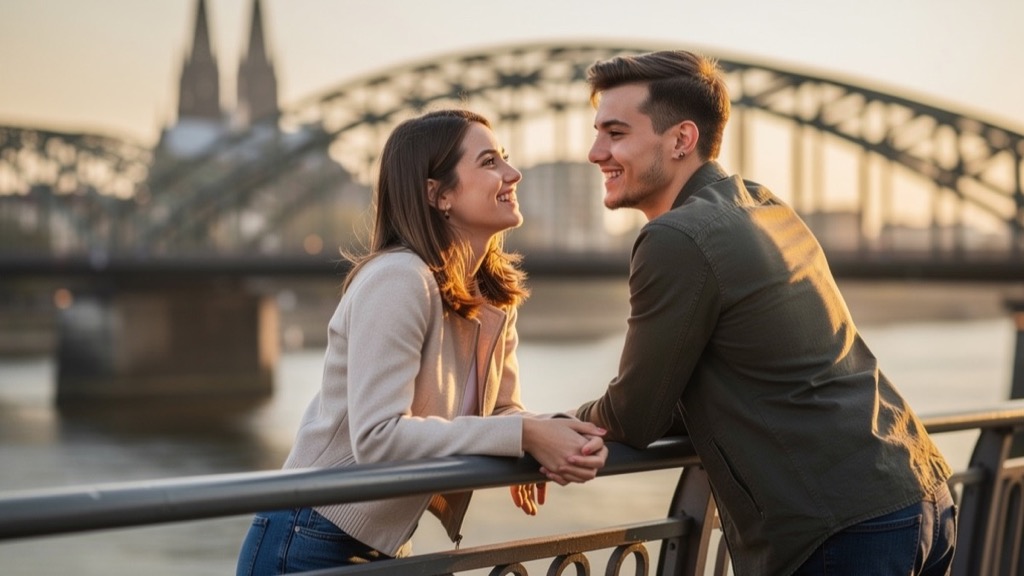
In everyday life, Cologne is a city by the water. On warm evenings plenty of people sit on the wide steps of the Rheinboulevard in Deutz, looking across at the cathedral and the old town, or on the meadows at Poll. Ehrenfeld, the Belgian Quarter and the area around the university are full of young people, Albanians included, just not as a recognisable group.
Striking up a conversation by the Rhine is easier than in many other cities. People in Cologne like talking to strangers, and that rubs off. Whether a conversation turns into more still depends on seeing each other again, though, and for that an app is the more reliable route.
Carnival and how relaxed things can be
No topic shows how differently Albanian families in Cologne live as clearly as carnival. For many who grew up here, Weiberfastnacht and Rosenmontag are simply part of the year, with costumes, friends and school parties going back to nursery. Other families prefer to stay at home on those days, out of faith, because of the drinking, or simply because it isn’t their tradition.
When you’re getting to know someone, that quickly becomes a question that reveals more than you’d expect. People who love carnival and people who avoid it often have different ideas about how much freedom a relationship needs and how much say the family gets. Talking about it beats being surprised in February.
That doesn’t mean only like-minded people fit together. Plenty of couples find a way where one celebrates and the other hears the stories on Ash Wednesday. What counts is that both know what they’re signing up for.
What apps can do in Cologne
In Cologne, the search radius is less about numbers than about how far you’re willing to travel. Twenty-five to thirty kilometres covers Cologne, Bonn, Leverkusen and Bergisch Gladbach. At 60 kilometres, Düsseldorf, Wuppertal, Duisburg and Essen come in, and suddenly you’re looking at half the Rhineland. If you don’t fancy the motorway in the evening, keep the radius deliberately tighter.
Dua is the largest Albanian pool in North Rhine-Westphalia, as it is everywhere. Cologne is also a big university city, so Tinder, Bumble and Hinge are strongly represented. You’ll find Albanians there too, but among a great many other profiles and without a filter that separates them cleanly.
On embla, the search radius for distance, age and language is always free. There’s no swiping: every day there’s a daily question, and with a reply spark you write directly to someone’s sentence, and the message lands straight in their chat. One a day is free, five with embla+. In a region full of profiles that helps, because you think about who you’re writing to instead of sending everyone a ‘hey’. embla isn’t in the App Store yet; for now there is a waiting list.
Cologne or Düsseldorf: who moves?
The rivalry between Cologne and Düsseldorf is an old joke on the Rhine, and plenty of Albanians from both cities happily join in. It gets serious when two people from either city fall for each other. Then it stops being a joke and becomes a question of where you want to live and whose family gets to be closer.
Between Cologne and Düsseldorf, that decision is smaller than it feels. Lots of people live in one city, work in the other and commute every day. Couples along the Rhine therefore often move where the rent fits and the train stops, not where one of them happens to come from.
Where dating in Cologne tends to lead
Cologne is an open city, and many young Albanians live that openness as a matter of course. At the same time, families are close, often just a few stops away. Dating in Cologne means bringing both together: the ease of an evening by the Rhine and the expectations at home.
In summer, many head home. Flights from Cologne Bonn and Düsseldorf take people to Kosovo, North Macedonia and Albania, and at the gate you often see families you know by sight from Cologne. If you meet someone from the Rhineland in Prishtina in August, you might see them again on the Rheinboulevard in September.
If you’re looking for someone from the region, there’s plenty of choice here. The real question is rarely whether there are enough people, but whether you agree early enough on how you want to live.